Serwis wymaga plików cookies do prawidłowego działania strony. Korzystanie z serwisu bez zmiany ustawień dla plików cookies oznacza, że będą one zapisywane w pamięci urządzenia. Ustawienia te można zmieniać w przeglądarce internetowej.
The best Polish website dedicated to the Greek island Crete and to a small extent of continental Greece. You will find useful information related to visiting Crete that goes beyond the offer of optional tours. On the website you will also find descriptions of the most interesting places that we visited by visiting this largest Greek island. The content complements the current news, photographs and recipes of Greek cuisine.
Greece's new spatial planning framework, or the transformation of the tourism sector
2026-05-13 19:17:16
Greece, a leading global tourism destination, is currently facing a fundamental shift in the way it manages its space and natural resources. The introduction of the Special Spatial Planning Framework for Tourism (EXP-T) represents a turning point, aiming to shift from uncontrolled growth towards sustainable development and the protection of national heritage.The new document is intended to serve as a "strategic compass" to guide investment in the coming decades, taking into account growing environmental pressures, climate change, and overtourism.
The need for a new framework arose from a long-standing legal loophole created by the repeal of previous regulations in 2009. For years, Greece operated without a unified system of regulations, which encouraged scattered, unplanned development and overexploitation of the most popular islands. The current reform divides the country into zones with varying potential and permissible tourist loads, introducing stringent limits where infrastructure and ecological capacity limits have already been exceeded.
The foundation of this transformation is the concept of carrying capacity , which is becoming the overarching criterion for granting permits for new investments. Using data from the record-breaking year 2025, in which nearly 38 million tourists visited the country, generating revenues of €23.6 billion, the Greek government concluded that further quantitative development without strict spatial regulations would lead to the irreversible degradation of the assets that make Greece attractive. Therefore, the new regulations place particular emphasis on the redistribution of tourist traffic, the promotion of alternative activities, and the protection of the coastal zone and environmentally sensitive areas.
Spatial categorization system and new investment rigors
A key element of the reform is the division of 1,035 local government units into five main categories based on tourist traffic, the number of available beds, and population density. This classification system will allow for the adaptation of building regulations to local specifics, while abandoning the current uniform approach across the entire country.
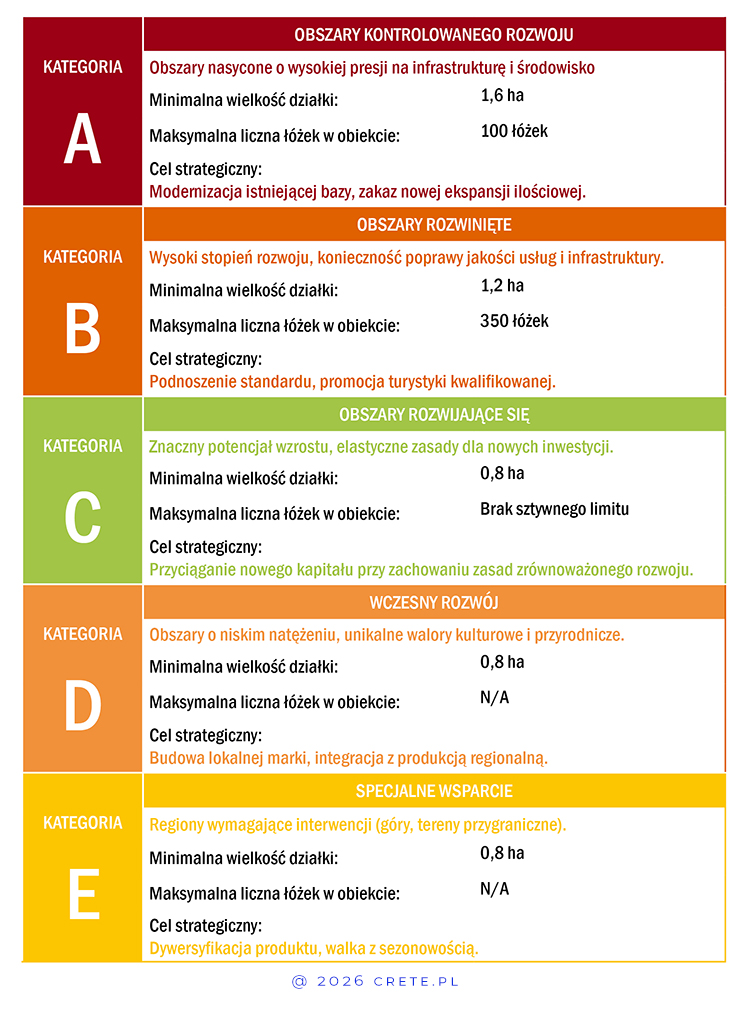
In the table, we have collected investment parameters assigned to individual categories, which will allow you to understand the scale of restrictions introduced in the most burdened regions.
Analyzing this data, it can be seen that in category A areas, the minimum plot size for hotel construction outside the city plan has been raised to 1.6 hectares, signaling to the market that the era of dispersed development on small plots is over. In practice, this means that new investors will be forced to consolidate land, favoring large, capital-intensive, high-end projects over smaller, often uncontrolled ventures.
The introduction of Category A (Controlled Development Areas) applies to 18 key urban areas designated as "red zones." These include the most prestigious locations, such as Mykonos, Santorini (Thira and Oia), Corfu Town, and parts of the islands of Rhodes and Kos. In these areas, the government's priority is to modernize and upgrade existing facilities to 4- and 5-star standards, while limiting the construction of new high-capacity units.
Classification of islands according to size and carrying capacity
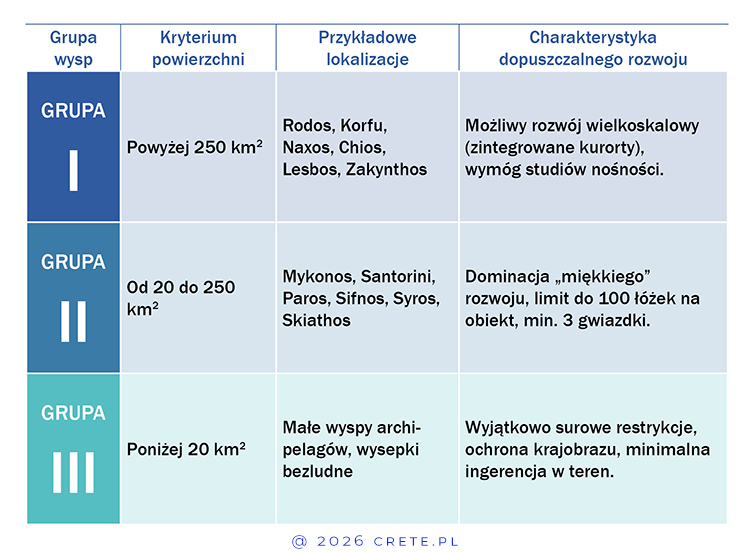
Due to their geographic isolation and limited resources (especially water), the Greek islands are subject to the most stringent and complex regulations. Excluding Crete and Evia, which are considered more continental due to their size, the remaining islands are divided into three groups, which determine their future investment profile.
For Group II and III islands, the regulations introduced aim to preserve the unique cultural and landscape identity that is being destroyed by mass development. On smaller islands, with an area of less than 1,000 hectares, only mild marine recreation, such as diving or sailing, is permitted, along with very limited accommodation such as glamping or low-density luxury residences.
An interesting solution is the " multi-track " system within the same island. An example is Corfu, where the city itself and its immediate surroundings are in Category A with a limit of 100 beds, while other islands will be able to afford hotels with up to 350 beds. This approach allows for targeted relief of local hotspots without completely hindering the economic development of the entire region.
Coastal Protection and Climate Change: The 25-Meter Limit
Greece has also decided to introduce an absolute protection zone along its coastline. The new spatial planning framework prohibits any construction or landscaping within 25 meters of the shore. This rule applies both where the coastal boundary has already been defined and where it is measured from the waterline.
The introduction of this zone has three main goals:
Ecosystem Protection : The beach and dune runway is crucial for biodiversity and natural protection from storms.
Public access : Greece has been struggling for years with illegal fencing of beaches by hotels and clubs; the new rule aims to guarantee free access to the sea for citizens and tourists.
Disaster resilience : Banning construction so close to water minimises the risk of property damage and life-threatening situations in the event of extreme weather events, which are becoming increasingly frequent in the Mediterranean basin.
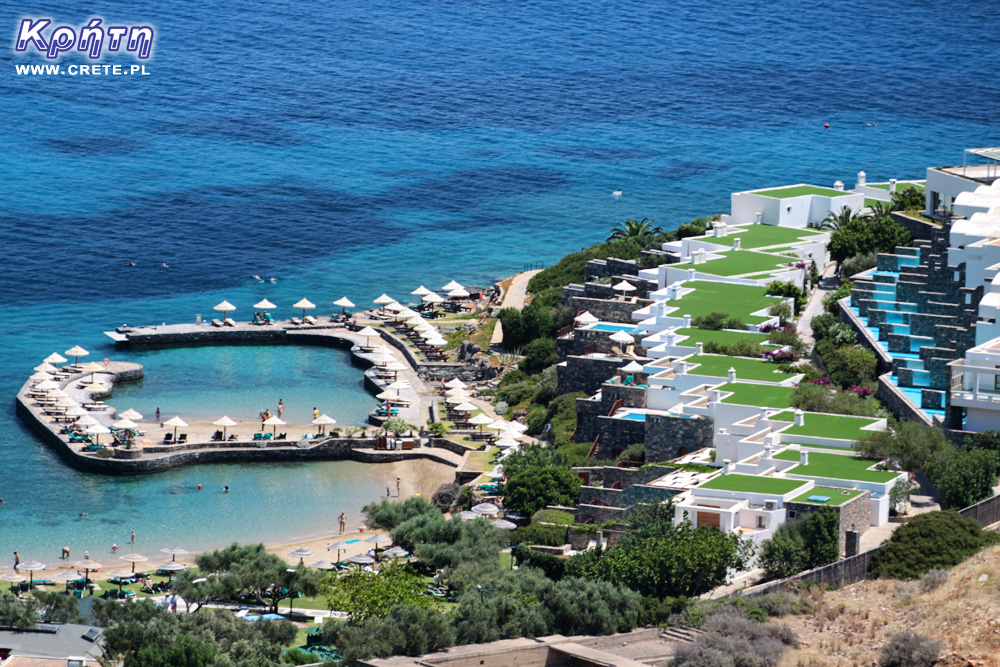
Exceptions to this rule are extremely narrow and apply only to infrastructure serving the public interest, such as disabled ramps, ambulance access, and essential port or security installations mandated by specific legislation. Investors planning new seaside developments must now design them with a significant setback from the shore, drastically changing the architecture of traditional " beach resorts " in Greece.
A New Era of Short-Term Rentals: Airbnb Under Strict Scrutiny
The growth of platforms like Airbnb in Greece has led to a sharp rise in property prices and a shortage of housing for permanent residents, especially in major city centers and on popular islands. A new spatial planning framework integrates short-term rentals with the overall limit on the area's tourist carrying capacity.
Limit mechanism
An innovative approach is to introduce a correlation between the number of hotel beds and the number of units permitted for short-term rentals. In areas deemed saturated (Categories A and B), the state reserves the right to freeze new Airbnb licenses if the total number of tourist beds exceeds a designated infrastructure capacity threshold. Local authorities gain the authority to designate "red zones" within municipalities where short-term rentals can be banned entirely or limited in time (e.g., to 90 days per year).
Tighter technical standards
From October 1, 2025, all properties offered on digital platforms must meet stringent technical requirements that bring them closer to professional hotel standards. For example, these include the deployment of 6kg fire extinguishers (one per 100m²), smoke detectors in every bedroom and kitchen, a ban on renting basements, garages, and storage rooms, and the possession of third-party liability insurance. Failure to meet these requirements results in penalties ranging from removal from platforms (Airbnb, Booking), delegalization, and a ban on re-registration, to financial penalties and criminal liability.
The introduction of these rules aims not only to level the playing field between hotels and apartment owners, but above all, to ensure the safety of tourists and protect the quality of the Greek tourism product. Since May 2026, thanks to EU Regulation 2024/1028, data exchange between digital rental platforms and the Greek tax office has been taking place in real time, virtually eliminating the gray zone.
Thematic and year-round tourism strategy
The spatial planning reform aims to break the monoculture of the "sun and sea" model. The Greek government is focusing on the development of alternative tourism, which is expected to become a driving force for the mainland regions, previously overshadowed by the Aegean islands.
The Mountainous Greece campaign and mountain tourism
The Ministry of Tourism has allocated €90 million from the Reconstruction Fund to create modern digital and physical infrastructure for mountain areas. The new regulations allow for:
Year-round operation of ski resorts: Transforming winter resorts into centers of active summer tourism.
Glamping Development: Introduce clear rules for luxury campsites that have minimal environmental impact and can be built near national parks.
Construction of shelters: Simplification of procedures for high-altitude accommodation facilities, taking into account local building materials.
Diving and sea tourism
Greece plans to become a leader in diving tourism in the Mediterranean. The new framework envisages the designation of special marine parks and facilitates the construction of small marinas on less developed islands (Categories C and D). A "soft development" model is being promoted, where seabed intervention is minimal and diving tourism also serves to monitor and protect marine ecosystems.
Health, Wellness and Conferences
In regions such as Attica and Thessaly, the development of spa tourism and modern conference centers will be promoted. The goal is to attract affluent business travelers and those seeking regeneration outside the peak summer season, allowing the season to be extended to a full twelve months.
Protection of Natura 2000 areas and cultural heritage
The new spatial planning framework is closely integrated with the European nature conservation system. In the event of any conflict between tourism needs and environmental protection requirements, the most restrictive regulations prevail.
Currently, as many as 68% of Greek Natura 2000 areas have already approved special environmental studies, which allows for a precise definition of what tourist activities are permissible in a given zone.
Traditional and abandoned settlements : instead of building new concrete structures, there will be financial incentives for investors who decide to renovate old buildings
Archaeological sites : introduction of buffer zones in which any activity that could disturb the historic landscape or disturb yet undiscovered archaeological layers is prohibited.
The new framework also prohibits the construction of large-scale renewable energy installations, such as wind farms or large-scale photovoltaic farms, directly adjacent to iconic tourist destinations (Category A), so as not to compromise their visual appeal. An exception is made for installations solely for the self-consumption of hotels, which is intended to support their green transformation.
Industry reaction
The reaction of major tourism organizations, such as the Association of Greek Tourism Enterprises and the Federation of Hoteliers, has been reserved. While the industry agrees with the need for the rules, it fears that some regulations could undermine the legal security of ongoing investments. Therefore, it is demanding guarantees that projects that have already received a positive environmental decision will be able to be completed under the old rules. The government has confirmed that the reform is not retroactive, a move intended to reassure international investment funds that have invested billions of euros in the Greek tourism real estate market in recent years.
The implementation of EXP-T, which is expected to be finalised with the signing of a Joint Ministerial Decision by the end of June 2026, will be closely watched across Europe as a potential model for dealing with overtourism in sensitive regions.
More euphoric comments are appearing in the foreign press. "Historic reform," "an example to follow," "a source of inspiration"—these are just some of the words used in articles. It's safe to say that the implementation of the new rules in Greece will be closely watched by many countries grappling with similar problems.
Nie do wiary - kraj którego 80 % terenu stanowią góry, gdzie płaski teren to rzadkość nagle postanowił rozwijać turystykę górską. Jaka będzie rzeczywistość się okaże - ja uwierzę gdy zobaczę że dbają o istniejącą infrastrukturę - bo to że mając fundusze potrafią wytyczyć ciekawe trasy wiem - ale nie potrafią ich utrzymać - obecnie jesteśmy w rejonie półwyspu Methana ( Peloponez wschodni ) gdzie kilkanaście lat temu wytyczono sieć szlaków - obecnie zarosły i zanikły, pozostając tylko na mapie.
Wypełnij poniższy formularz aby dodać komentarz
lub kliknij w poniższy link aby skorzystać z możliwosci komentowania przez facebooka: https://www.facebook.com/crete.poland/posts/1394538246053769
gość dodekanezowiec Z pewnością Hiszpania ma większy problem z turystyką - vide: Majorka czy Benidorm (hotele na 50 pięter).
Z drugiej strony - włoska Kalabria się zachowuje tak jak gdyby nie chcieli turystów. Tam jest cisza i spokój, hotele na wygwizdowiu, poza Tropeą i paroma miasteczkami nudy totalne. Na Sycylii niewiele lepiej - jakie tam są miejscowości dla turystów, gdzie nie będzie się on nudził? Też na palcach ręki by policzyć. (...)
gość PiotrWie Jeździliśmy na Kretę od 2008r, bywały lata że byliśmy w kilku kawałkach w sumie czterdzieści kilka dni ( samoloty z Wrocławia latały w piątek wieczorem tak że można było polecieć po pracy, powrotem był w poniedziałek w nocy więc za 11 dni urlopu można było być 17 dni, jak się zaplanowało z jakimś świętem to można było być 2 x 17 dni i raz 10 dni) i z roku na rok było coraz więcej ludzi - nie tylko na plażach ale ... (...)
Czy wyspa jest w stanie pomieścić 15 mln turystów, zapewne tak. Pytanie moje: skąd będzie woda?! Jak już brakuje, tama na Aposelemis sucha, gdzie ścieki popłyną, gdzie będą składowane śmieci??? Smutne, że wyspa zamienia się na globalną destynację.. rozumiem, że pieniądze są ważne ale żeby dewastować naturalne tereny np.triopetra, plakias etc... przykro
Można próbować zrozumieć ludzi, którzy z tego żyją. Można też puścić ludzi na żywioł i nie zajmować się takimi głupotami, jak ofiary śmiertelne. Samaria nie jest szlakiem w 100% bezpiecznym (który szlak jest), to głęboki wąwóz, narażony na erozyjne osunięcia skał. Poza ty, to jest region aktywny sejsmicznie i dość kapryśny pogodowo.
Myślę, że tu nie ma miejsca na ustępstwa. (...)



 2026-05-13 19:17:16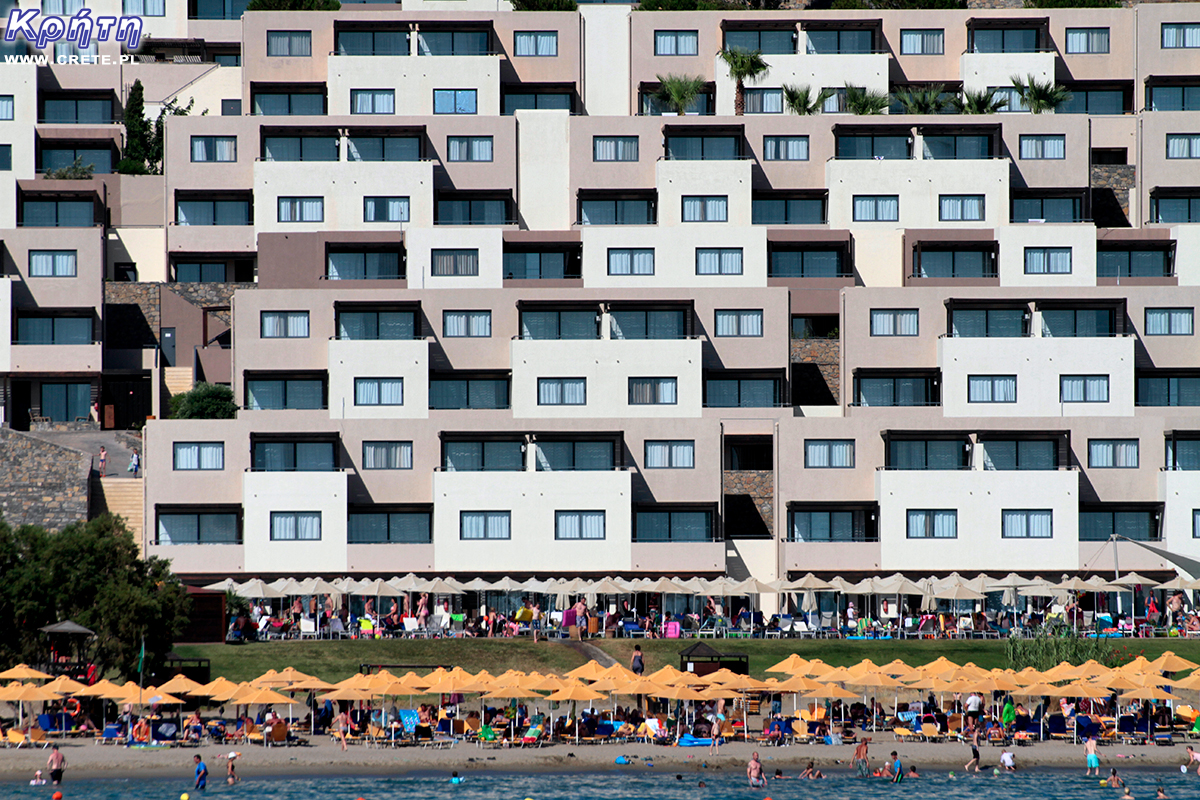

Komentarze
Nie do wiary - kraj którego 80 % terenu stanowią góry, gdzie płaski teren to rzadkość nagle postanowił rozwijać turystykę górską. Jaka będzie rzeczywistość się okaże - ja uwierzę gdy zobaczę że dbają o istniejącą infrastrukturę - bo to że mając fundusze potrafią wytyczyć ciekawe trasy wiem - ale nie potrafią ich utrzymać - obecnie jesteśmy w rejonie półwyspu Methana ( Peloponez wschodni ) gdzie kilkanaście lat temu wytyczono sieć szlaków - obecnie zarosły i zanikły, pozostając tylko na mapie.
Wypełnij poniższy formularz aby dodać komentarz
lub kliknij w poniższy link aby skorzystać z możliwosci komentowania przez facebooka:
https://www.facebook.com/crete.poland/posts/1394538246053769